
01
Dashboard
The live market overview: the All-Assets composite, category performance, market heatmap, breadth, movers, the benchmark leaderboard, and the Liv-ex-powered Wine Market section.
Learn how Rare Index works and how to get the most from the platform.
Last Updated: July 2026
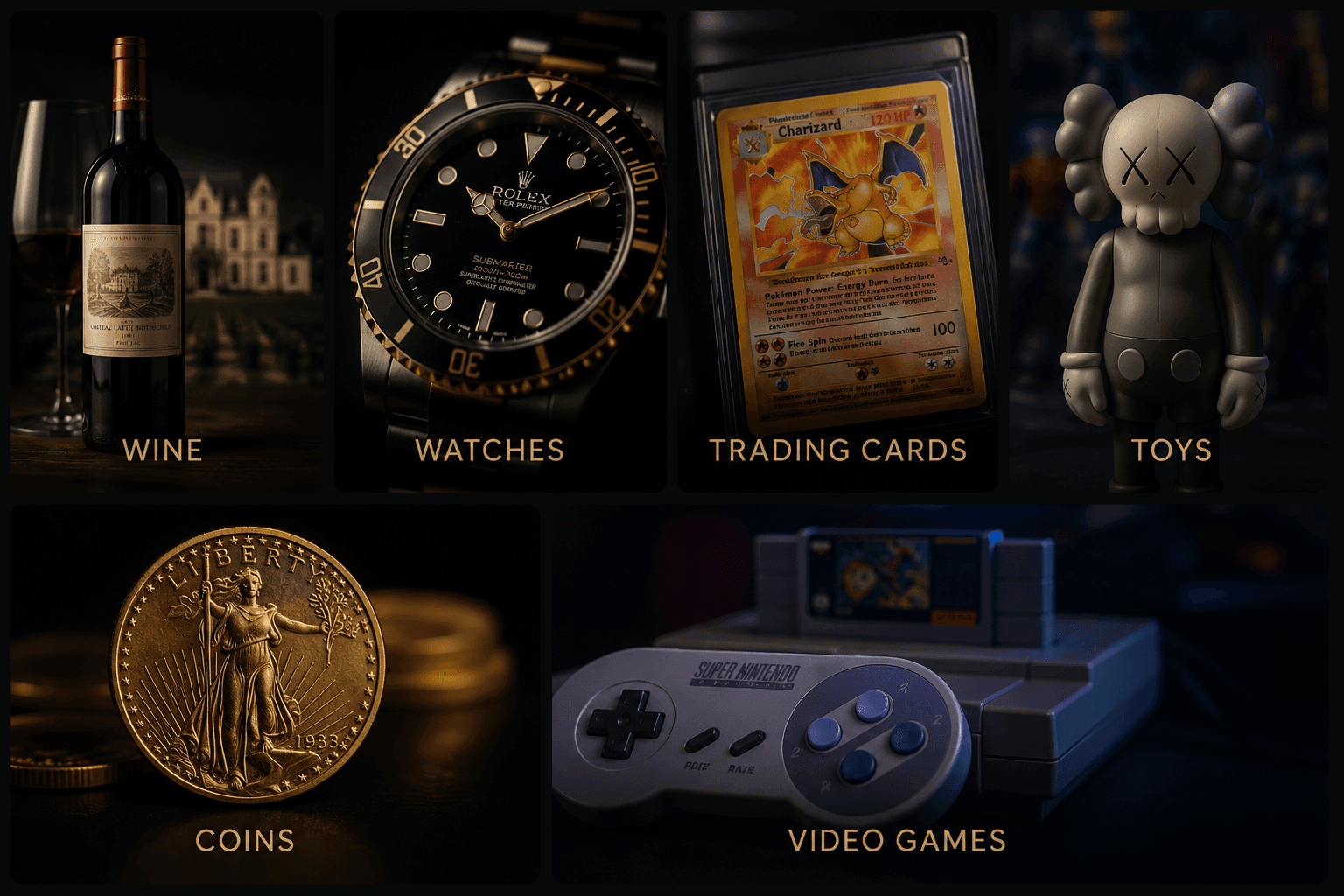
Rare Index is a market intelligence platform for the alternative asset economy. The platform consists of core modules designed to help collectors and investors track, analyze, and benchmark alternative assets.
The live market overview: the All-Assets composite, category performance, market heatmap, breadth, movers, the benchmark leaderboard, and the Liv-ex-powered Wine Market section.
Rare Index category composites, WatchCharts watch data, and Liv-ex wine indices in one market table, with performance windows and full history charts.
The searchable asset database across Cards, Watches, Wine, Video Games, Toys, Coins, Jewelry, and Other — with filters, sort, and asset detail pages.
Side-by-side asset comparison across metrics, performance, and market data.
Auction intelligence across the alternative asset market, including historical results and house coverage.
Track holdings, market values, allocation, cost basis, and performance against market benchmarks.
Save and monitor assets before adding them to a portfolio.
A planned structured record layer linking to third-party grading and authentication records. Rare Index does not provide grading, appraisal, or legal authenticity guarantees. Planned.
Rare Index aggregates and normalizes data from first-party inputs, public market information, and licensed third-party providers. Our data pipeline processes daily snapshots across 17+ sources, built on 100M+ price observations.
Third-Party Data Sources: Rare Index integrates with pricing providers, market reference databases, and transaction data services across multiple categories. Data availability and refresh frequency vary by category and source. Rare Index may add, replace, or discontinue integrations to maintain data quality and accuracy.
Our data coverage spans 8 configured categories. Coverage depth varies by category and grows as partnerships and history accumulate:
Cards — Pricing data from multiple card market providers covering sports cards, Pokemon, Magic: The Gathering, and other TCG products. Includes both market pricing and historical sales data.
Watches — Market data powered by WatchCharts, covering ten major brands (Rolex, Omega, Patek Philippe, and more) plus the overall watch market index.
Wine — Fine wine intelligence powered by Liv-ex, including the Fine Wine 1000, Bordeaux 500, and Champagne 50 indices on a monthly publication cadence.
Video Games — Pricing and transaction data for retro and modern titles, including cartridge and disc releases, from sources such as PriceCharting.
Toys — Pricing data from toy and collectibles market providers, covering Funko, action figures, LEGO, and related brands.
Coins — Market data covering collectible and numismatic coins. Coverage is active and expanding as history accumulates.
Jewelry — Governed jewelry market coverage publishes as source history becomes available.
Other — The governed catch-all category for assets that do not belong to another first-class category.
Data is normalized, cleaned, and validated before display. Every price point is attributed to its source where source-level detail is available. Update cadence depends on category, source, and license constraints.
Rare Index continuously transforms raw market observations into standardized, institutional-grade market intelligence through a governed multi-stage computation pipeline. The engine performs identity resolution, normalization, pricing, confidence scoring, signal generation, and index computation before publishing immutable serving datasets consumed by the Terminal.
Cards, Watches, Wine, Video Games, Toys, Coins, Jewelry, and Other composites across the market table. Wine rows carry Liv-ex index data; watch rows carry WatchCharts-attributed market intelligence.
An equal-weighted composite of published category benchmarks. Each category is normalized to 100 at its own first observation and joins the composite as its history begins — the basis is always disclosed.
Individual brand indices track performance at the brand level within each category, published alongside the category composites.
Price data is normalized for condition, grade, source attribution, and confidence. Outliers and anomalies that could distort index performance are excluded. Where a value cannot be computed from served history, the platform shows an honest em-dash — never an estimate.
Rare Index values update as source data is processed; Liv-ex wine series follow a monthly minimum cadence and do not imply daily per-bottle pricing.
RI Certification is a planned structured record layer for supporting documentation and third-party references. It is not an appraisal service and will not authenticate items directly.
Always verify authenticity through qualified third-party grading services before making significant purchases. RI Certification is a data layer, not a substitute for professional authentication.